
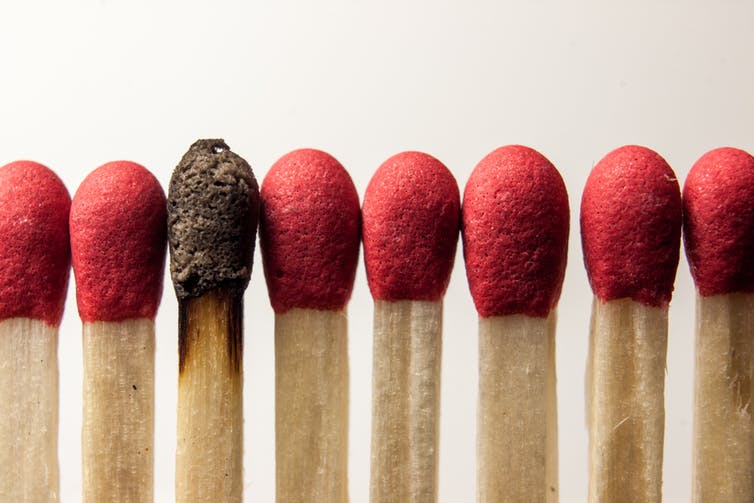
Extinguished and anguished: what is burnout and what can we do about it?

Burnout doesn’t only affect workers.
from www.shutterstock.com

Gabriela Tavella, UNSW and Gordon Parker, UNSW

Feeling “burnt out” is a pretty common phrase in daily parlance, but we’re starting to learn more about its longer-term destructive effects. Sufferers often describe feeling exhausted and disconnected, and as though they’re “going through the motions” without motivation or meaning.

Burnout can have serious consequences, including reduced work performance and life satisfaction, and has been associated with other mental health conditions. For instance, it has been linked to depression, as both conditions share a number of symptoms such as fatigue, social withdrawal and decreased work performance.


Read more:
Health Check: Stressed at work? How to beat common traps in the rat race


Burnout is usually seen as a consequence of a chronic stressful work environment, emerging as a workplace concern in the 1970s when American researchers found many human services workers were not coping with their jobs and felt “burnt out”.

The workers reported:

• emotional exhaustion: becoming emotionally drained and fatigued

• depersonalisation: a loss of empathy towards clients

• reduced personal accomplishment: feeling incompetent and inept at work.

Since then, burnout research has expanded across other occupations and its definition modified to include cynicism towards work.

However most research still focuses on work-related burnout. But people from all walks of life may experience burnout, and not just from work. For example, burnout may also be experienced by students who are overwhelmed by their study commitments, or a mother (or carer) caring for a severely disabled child.

The risk of burnout for those in caring roles is not a new phenomenon. Records from Christian monks of the 4th Century outline what they call “acedia” (a Greek word which translates as “non-caring”), a state probably akin to burnout. After decades of caring for others, the monks were said to have doubted whether they were doing anything useful and judged each day as “grey”.

Burnout appears to occur across a range of contexts, but we do not know enough about its causes and how to diagnose and manage it successfully.


Read more:
Overworked? Good habits, not holidays, are the answer


Causes

We know job-related burnout can be triggered by exposure to multiple and continuing work stressors. While such stressors may differ across occupations, they relate to the demanding and unrelenting nature of a job, combined with a toxic mix of lack of resources and support.

Burnout can also be triggered by certain personality traits. For instance, research has linked burnout to a person’s evaluation of themselves and their abilities, a trait known as core self-evaluation.

Full-time carers can experience burnout.
from www.shutetrstock.com

Low core self-evaluation is when someone has negative views about their own skills and ability to control situations. People with low core self-evaluation are susceptible to burnout as they likely view difficult work assignments as threatening or overwhelming, rather than achievable challenges.

Perfectionists are also at greater risk of burnout, as they tend to set excessively high performance standards they inevitably fail to meet, thus diminishing their sense of personal accomplishment.

Measurement and diagnosis

The main tool used in research studies to measure burnout is called the Maslach Burnout Inventory (MBI), a survey that requires individuals to answer several questions relating to emotional exhaustion, depersonalisation/cynicism and reduced personal accomplishment.

But it has been widely criticised due to concerns it doesn’t accurately capture the concept of burnout, is not culturally sensitive for use outside of the United States, and was designed to measure burnout in individuals still in the workforce – not those who have stopped working as a consequence of clinical burnout.

In addition to the issues surrounding measuring burnout in a research context, it is also difficult to diagnose in clinical settings. This is because the condition is not recognised in the Diagnostic and Statistical Manual, used internationally to diagnose mental health disorders. So there is no set of indicative criteria for mental health professionals to use to diagnose people suffering from clinically significant burnout.


Read more:
Clock off, switch off: tips to stress less outside work hours


This in turn influences treatment, as without a concrete diagnosis it’s difficult for mental health professionals and their patients to make decisions about appropriate treatment.

Management

Management strategies remain quite unclear, however should be targeted to individual sufferers. This means addressing the unique stressors that contribute to burnout in each person.

Management strategies should also acknowledge the individual’s personality style. Strategies that work to remove external stressors (such taking a month off work and lying on a beach) might assist some sufferers, but might further stress others whose personalities don’t allow them to “switch off” outside the office.

Personality styles are generally thought to be unchangeable across a person’s lifespan. So for those who have personality traits that put them at extra risk of burnout, it has been suggested they be taught techniques that help them cope more effectively with external stressors, rather than trying to change their personality.

The ConversationSuccessful interventions to prevent and treat burnout depend on a more complete understanding of the condition. Our team at the Black Dog Institute is currently conducting a study that should assist in defining and measuring burnout and its principal causes. You can participate in our study here.

Gabriela Tavella, Research Assistant, UNSW School of Psychiatry, UNSW and Gordon Parker, Scientia Professor, UNSW

This article was originally published on The Conversation. Read the original article.

How burnout is plaguing doctors and harming patients

Exhaustion and burnout among physicians are growing problems.
wavebreakmedia/Shutterstock.com

Jay Desai, University of Southern California

The presidential symposium at this year’s Annual Meeting of the Child Neurology Society of America in early October in Kansas City raised many eyebrows. The first presentation of this symposium focused on burnout rates among neurologists around the country.

Many of my colleagues felt that this was an inappropriate choice, especially with so many trainees and young child neurologists in the audience. Typically, the presidential symposium at a conference of such eminence addresses an issue of scientific importance. But some other colleagues felt that this discussion was essential and that the elephant in the room cannot be ignored anymore.

As I sat through it, I felt that the presentation was outright depressing, with speakers belting out dismal data about the state of mind of neurologists around the country. The most striking statistic was that about 60 percent of neurologists in the U.S. were experiencing burnout symptoms, including emotional exhaustion or lack of a sense of accomplishment. They also showed signs of depersonalization, which is an impaired perception of self and others that can lead to lack of empathy, including for patients.

I have been taking care of patients for more than two decades since graduating from medical school in 1994. I had not even heard of physician burnout until about four years ago when a lot of data started getting published. However, it is now a subject of discussion among physicians on wards, in clinic and at conferences, as we all realize that it is a menace.

The core that provides care

Unsurprisingly, the rot extends beyond the field of neurology. Several reports recently have highlighted that physician burnout rates across many major specialties in the U.S. have reached epidemic proportions. For example, a survey earlier this year suggested that the physician burnout rate exceeded 50 percent for the fields of emergency medicine, obstetrics and gynecology, family medicine, internal medicine, critical care, anesthesiology, pediatrics, neurology, urology, cardiology, rheumatology and infectious disease.

This is bad for doctors, and it’s bad for patients. Physician burnout is a public health hazard, because it is a danger to patient safety and leads to poorer care.

The presidential symposium got me thinking about my own professional life. Was I positive about my career? What made me continue to pursue the practice of neurology? And, did anyone at work inspire me to remain engaged?

As I reflected on these questions about what helps me avoid burnout, an obvious answer came immediately: I knew that I continually looked up to two senior physicians in my division who trained me to be a child neurologist about a decade ago and now happen to be my colleagues.

But then I realized that there were some others who served as my inspiration at a subconscious level.

One of them is a medical social worker who joined us just a few months back. Imposing in stature, with a crop of curly high-top hairdo that makes him appear even taller, he is at ease when interacting with kids and parents alike. The focus of his work is to provide support to families that are overwhelmed with the care of children with chronic neurological illnesses. I can rely on him to come up with solutions to any of my patients’ problems, whether it is finding mental health support or getting insurance coverage. And he manages to handle an extremely demanding schedule without ever appearing to be hurried. While many of us dread electronic medical record keeping, his notes wondrously manage to not only incorporate precise wordings but also have the most aesthetically pleasing fonts.

The other co-worker who inspires me guards the front desk of our office. He ushers in patients and their families. This may not sound like an important job to laypersons. But he gives a new meaning to the art of making a first impression, the art of putting sick patients and their families at ease. And he does so day in day out with warmth that few can ever manage to radiate.

The four individuals mentioned above have little in common, except that they directly interact with and take good care of patients and their families.

The superstructure

At the same time, I, like most doctors across America, have scores of colleagues who never interact with a patient or directly contribute to the actual care. These include billers, coders, financial counselors, accountants, managers, directors, strategists and so on. They play an increasingly critical role in the complex multi-payer health care setup as it operates today.

Unfortunately, the nurses, the therapists, the physicians, the pharmacists, the social workers – the folks who interact with patients and directly contribute to the provision of care – are arguably becoming smaller in their significance within the health care system of America.

The entire industry’s focus seems to have shifted to administration and the business side of medicine. There are data to support this: We spend way more on administrative costs than any other country around the world to deliver care, particularly in the hospital setting. This shift in focus is likely the central cause of burnout.

Can the setup be overhauled or the course be reversed?

My grandfather once risked his life and crossed a flooded river on a horseback to steer a woman in the midst of a complicated labor to safety. He treated the poor free of charge, and he took money from the rich to build a hospital in an area of India where medical care was in short supply. He had nothing much to worry about then, except his conscience.

In 21st-century America, we can’t hope to recreate such a utopian scenario. But we can certainly restructure the health care setup enough to help us restore some of the passion. In my opinion, adopting a single-payer health care system will help cut administrative layers. A majority of physicians in the U.S. support moving to a single-payer model, according to a recent survey.

The ConversationI offer an additional or an alternative solution, one that will require innovative strategies to implement: Any person engaged in the health care industry in an administrative capacity ought to spend at least 20 percent of time and effort in interacting directly with patients. This will put the patients back in the focus and bring passion back into the field of medicine.

Jay Desai, Assistant Professor, University of Southern California

This article was originally published on The Conversation. Read the original article.